SAANYS Provides Testimony to Assembly on Chronic Absenteeism
Testimony of the School Administrators Association of New York State
2026 Assembly Education Committee and Children and Families Committee
Legislative Hearing – Chronic Absenteeism and Low Attendance
Albany, New York – January 22, 2026
Presented by Christine Arlt, SAANYS President
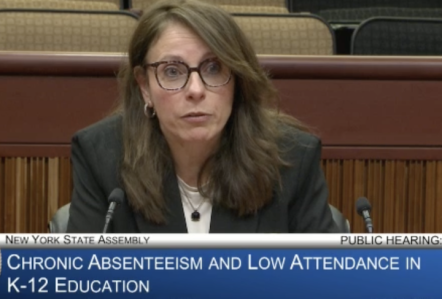
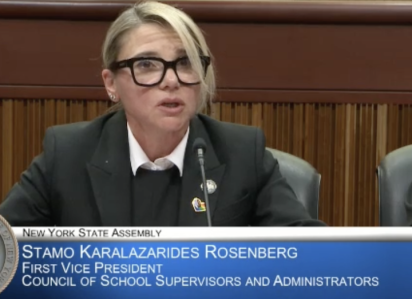
Representing SAANYS was SAANYS President Christine Arlt. Joining Arlt was Stamo Karalazarides Rosenberg, first vice president of the Council of Supervisors and Administrators of NYC.
Full Testimony:
Chairpersons Benedetto and Hevesi, honorable members of the Legislature, and distinguished staff, thank you for the opportunity to provide testimony on the challenges facing school districts related to chronic absenteeism and low attendance.
My name is Christine Arlt, and I serve as President of the Board of Directors for the School Administrators Association of New York State (SAANYS). SAANYS represents more than 14,000 active and 8,000 retired building administrators and program directors from the Big Five city school districts and the majority of school districts across New York State.
SAANYS appreciates the Assembly’s longstanding support for public education, and particularly for building-level administrators. You have consistently demonstrated openness to dialogue and a willingness to engage on complex educational challenges. This hearing on chronic absenteeism further reflects your commitment to understanding multifaceted issues and ensuring that state-level policy is informed by practitioner and stakeholder input.
Current Challenges
This fall, SAANYS conducted a comprehensive member survey to establish baseline information on the priorities and needs of public school administrators for the 2025–26 school year. School attendance emerged as the highest-ranked challenge statewide.
Survey responses indicate that student disengagement is the primary driver of absenteeism. Administrators reported increasing levels of student isolation and disconnection from school, peers, and learning. Health-related issues and family responsibilities were identified as the next most common causes of absenteeism.
When asked to elaborate, many respondents referenced a post-pandemic shift in attitudes toward attendance, including competing family priorities, a diminished perceived value of daily school attendance, negative perceptions of schools generally, and significant disengagement—particularly among high school students.
Background and Statewide Trends
Prior to the COVID-19 pandemic, chronic absenteeism rates in New York State generally ranged between 13 and 15 percent. During the 2021–22 school year, absenteeism reached an unprecedented high of 33 percent. Building administrators were on the front lines of this disruption and now face the monumental task of reversing these trends.
In the 2024–25 school year, absenteeism has shown modest improvement, with rates estimated between 29 and 31 percent, remaining far above pre-pandemic levels.
| School Year | NYS Chronic Absenteeism Rate | Trend |
| 2018–2019 | 18.6% | Pre-Pandemic |
| 2021–2022 | 32.6% | Pandemic Peak |
| 2023–2024 | 32.2% | Leveling Off |
| 2024–2025 | ~30.5% (Preliminary) | Current Estimate |
Source: New York State Education Department
Absenteeism rates vary significantly by grade level and district type. When charted by grade, rates resemble a U-shaped curve—highest in prekindergarten and kindergarten, lower during elementary and middle school, and rising again in high school.
Certain student populations experience particularly high rates of chronic absenteeism, including:
- Students with disabilities (approximately 71%)
- Students in temporary housing (approximately 52%)
Rates are also higher in large city districts and among students experiencing housing instability.
Policies That Impact Absenteeism
From the perspective of school administrators, several state and local policies directly affect attendance.
Required Instructional Time
New York State requires school districts to provide at least 180 days of instruction annually, with minimum instructional hours by grade level:
- Half-day kindergarten: approximately 2.5 hours per day
- Grades K–6: 5 hours per day
- Grades 7–12: 5.5 hours per day
Within this framework, districts face increasing constraints. The growing number of state and federal holidays, contractual closures or reduced time, Regents examinations, grades 3–8 testing, and mandated school calendar requirements significantly limit available instructional days. These closures place added strain on families seeking childcare or supervision, which can further undermine attendance.
High absenteeism also results in lost instructional time, frustrating teachers and disrupting continuity of learning. Sustained academic progress requires focused, consistent engagement, and repeated absences significantly impede student outcomes.
Federal Accountability Requirements
The federal No Child Left Behind Act introduced heightened attention to student participation through assessment participation rates. Over time, this accountability framework expanded to include chronic absenteeism as a key measure.
Schools and districts identified with high absenteeism rates are subject to accountability requirements and improvement designations. Addressing these mandates often requires additional staffing or reassignment of personnel—resources that many districts struggle to fund or sustain.
Enforcement of Compulsory Education
New York State mandates compulsory education for students ages 6 through 16, yet local districts retain flexibility regarding school entrance age and enrollment policies. Some districts require attendance at age five, while others apply a December 1 or December 31 cutoff. As a result, compulsory attendance is not standardized across the state.
Effective enforcement of compulsory education requires dedicated resources. Historically, districts could refer chronic absenteeism cases to social services; however, those mechanisms and personnel are largely no longer available. The state has increasingly shifted toward a “support first, report second” approach, which, while appropriate, requires adequate staffing and community-based services to be effective.
School Funding and Enrollment Volatility
Attendance challenges are compounded by uneven funding structures, enrollment volatility, and sudden population surges. Districts enrolling students from other countries or cultural backgrounds often require immediate additional supports to assist with transitions. However, state aid for these students is typically lagged by a year, limiting districts’ ability to respond in real time due to staffing and funding constraints.
Prekindergarten Policies
The expansion of prekindergarten programs has been one of New York State’s most significant educational achievements over the past decade. However, prekindergarten also exhibits high rates of chronic absenteeism. While these two grade levels are not mandated, once a child enrolls in kindergarten or prekindergarten the attendance policy of the school district must be applied.
Many pre-k programs operate on a half-day schedule, which can be challenging for families with young children, particularly when attendance is required for only a 2.5-hour program. Additionally, transportation aid is not universally provided for prekindergarten, creating barriers for families and limiting consistent attendance. These challenges are further complicated by the lack of alignment between prekindergarten participation and compulsory education requirements.
Societal and Cultural Factors
Numerous reports—including those from the RAND Corporation and All In for Attendance—have documented a fracturing of the unwritten social contract between families and schools since the pandemic. Historically, families ensured regular attendance in exchange for schools providing quality education and pathways to opportunity.
Post-pandemic, many parents have become more relaxed about attendance, influenced by broader societal shifts in work, time, and remote engagement. Increased access to distance learning and remote instruction has altered perceptions of when and where learning must occur.
Parents also report heightened anxiety about sending children to school due to concerns about school safety, bullying, online influences, media coverage, and immigration enforcement. At the same time, many students report feeling disengaged, isolated, or alienated from school and peers—conditions that are incompatible with strong attendance.
Collectively, these factors contribute to a growing perception that daily school attendance is no longer a priority.
Strategies Schools Are Using
Despite these challenges, districts are implementing multiple strategies to address absenteeism:
- Enhanced data tracking to identify chronically absent students, distinguish excused and unexcused absences, and analyze trends. Based on the data, schools have revised policies by including parents, staff and community members in their development. Some policies have strengthened enforcement of attendance and increased curricular and extracurricular programs for engagement.
- Tiered support systems, including multidisciplinary teams that focus on strengthening school culture, student belonging, and engagement. Schools have implemented mentoring programs, flexible scheduling options, expanded extracurricular opportunities, and personalized outreach.
- Incentive-based approaches, directly to students with high attendance rates.
- Targeted interventions, modeled on case management, that provide individualized supports to students and families based on identified barriers to attendance.
Conclusion
This hearing underscores an essential truth: chronic absenteeism is not merely a behavioral issue—it is a symptom of deeper systemic challenges. In a relatively short period, the social contract between families and schools has weakened. Advances in technology, expanded remote learning, rigid calendar requirements, and contractual constraints have all reshaped how instructional time is defined and delivered.
School districts cannot resolve these challenges through isolated strategies alone. Meaningful progress will require:
- Reexamining school calendars and instructional time requirements
- Aligning compulsory education mandates with enforceable, well-resourced systems
- Providing districts with timely funding and staffing flexibility
- Recognizing that schools cannot address absenteeism in isolation
SAANYS appreciates the Legislature’s attention to this critical issue and looks forward to continued collaboration to ensure that policies reflect the realities faced by students, families, and school leaders across New York State.
Thank you for the opportunity to testify.