SAANYS Provides Testimony to Assembly on Education Funding
Testimony of the School Administrators Association of New York State
2026 Joint Legislative Budget Hearing
Elementary and Secondary Education Executive Budget Proposal
Albany, New York – January 29, 2026
Presented by Dr. Cynthia Gallagher, SAANYS Director of Government Relations
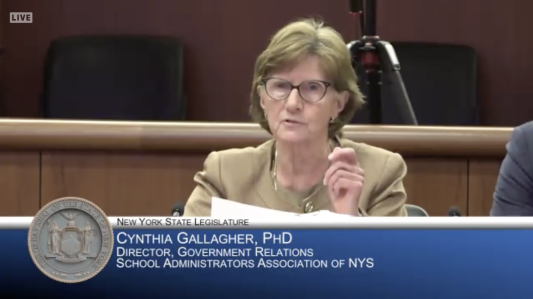
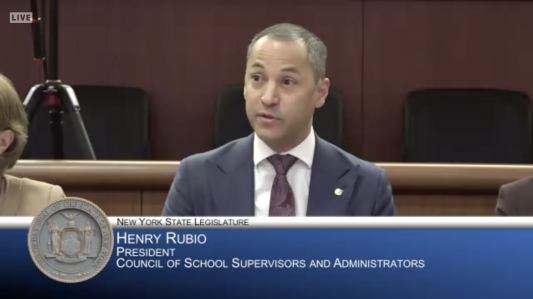
Representing SAANYS was SAANYS Director of Government Relations Dr. Cynthia Gallagher. Joining Dr. Gallagher was Henry Rubio, President of the Council of Supervisors and Administrators of NYC.
Full Testimony:
Committee Chairpersons Krueger and Pretlow, Chairperson Mayer, Chairperson Benedetto, honorable members of the legislature and distinguished staff, thank you for the opportunity to provide testimony on funding for elementary and secondary education contained in the executive budget for FY 2027.
My name is Cynthia Gallagher, and I serve as the director of government relations for the School Administrators Association of New York State (SAANYS). SAANYS represents building administrators and program directors from the Big 5 cities and the majority of districts in the rest of the state. Our membership has grown to over 22,000 active and 8,000 retired building administrators and program directors across the state.
SAANYS appreciates the Governor’s continued commitment to education and the steady leadership shown under challenging circumstances. We look forward to continuing to work with the Governor and Legislature to strengthen New York’s schools and communities.
Background
Each fall, the School Administrators Association of New York State (SAANYS) conducts a survey of its members to identify the most pressing challenges facing school leaders across the state. The results of this year’s survey indicate that the top challenges are student attendance, student mental health needs, staff vacancies, and the potential for funding reductions.
These challenges must be understood within the broader and continuing context of the aftermath of the pandemic and changing federal directives. The post-pandemic effects are still moving through the educational system. Many students currently in their upper high school years experienced significant disruption during their middle school years, a critical stage for academic development and social-emotional growth. The consequences of those disruptions continue to manifest in classrooms and school communities. At the same time, students now in the early elementary grades often entered school without the benefit of early care or prekindergarten experiences, further compounding learning and developmental gaps that schools are working diligently to address.
In addition to these educational challenges, schools are serving students and families who are facing significant external pressures, including uncertainty related to immigration policies, economic instability, and unemployment. These conditions have contributed to an increasingly fragile educational ecosystem in which schools are expected to respond not only to academic needs, but also to a wide range of social, emotional, and family-related challenges.
This context is directly relevant to the discussion of state funding. During recent testimony on absenteeism, a question was raised regarding how continued annual increases in funding could still be insufficient to address these persistent and emerging challenges. The answer lies in the expanded role schools are now required to play. School districts today are doing far more than was ever anticipated when many state aid structures were designed. As community-based support, such as social services and mental health systems have become increasingly strained or diminished, schools have assumed responsibility for addressing these unmet needs, often without corresponding resources.
This reality underscores the urgent need to revisit and modernize the Foundation Aid formula. While increases in aid are critical, they are insufficient if the underlying formula does not reflect current student needs, district responsibilities, and the true cost of providing a sound basic education.
State Aid
We appreciate that the Executive Budget continues to increase overall State education aid. Fully funding expense-based aid and modifying building aid to allow for renewable energy costs are positive elements of the proposed budget.
Foundation Aid and School Funding
In April 2024, the State tasked the Rockefeller Institute to conduct a study and issue recommendations concerning the Foundation Aid formula. The resulting December 2024 report found that the Foundation Aid formula was significantly out of date and recommended that multiple changes be made throughout the course of the next three to five years. Consistent with the recommendations herein, it was also noted that there should be additional, ongoing studies into various aspects of the formula that will keep it relevant to the ever-evolving nature of school communities and the services it provides. While the first steps towards changing the formula were made last year, there is still significant work to be done.
The ongoing challenge before the State is to modify the Foundation Aid formula so that it more accurately reflects the current needs of students and the realities facing school districts. The proposed increase to Foundation Aid of approximately 3 percent is a positive starting point. However, this increase does not adequately reflect the financial realities facing school districts, including rising inflation, escalating operational costs, and significantly increased student needs.
The full application of the Foundation Aid formula in the prior fiscal year marked a significant milestone toward the goals that the legislature and education stakeholders have worked towards. While this was an important step forward, the use of the formula in its entirety also brought into sharper focus a number of long-recognized shortcomings. Once fully implemented, it became clear that, if Foundation Aid alone had been used to determine aid levels, a substantial number of school districts would have remained, or been newly identified as “save harmless.” To prevent that outcome and to ensure stability across all districts, the FY 26 enacted budget included a uniform two percent increase in aid for school districts statewide.
This year, the Executive Budget does not provide for a 2 percent minimum increase across all districts. Instead, the proposal includes only a 1 percent minimum increase. At the 1 percent level, the number of districts relying on save harmless provisions will increase. This is a clear indication that the Foundation Aid formula itself is no longer functioning as intended and , requires significant revision.
Recommendations
- Undertake a comprehensive “Successful Schools” study to ensure that the Foundation Aid formula reflects the current student population and the true cost of successfully educating a student. As noted in the December 2024 Rockefeller report, the definition of a “successful school” has not been updated since 2015. Temporary measures were recommended while “policymakers await the outcome of longer term, more detailed costing-out research and modeling efforts.” (Rockefeller Institute of Government, December 2024, p. 12)
- The Foundation Aid formula must be updated to reflect expanded curricular mandates, an increased number of students with limited English proficiency, and increased needs for social and emotional support. These changes, as well as expected changes to graduation requirements and increased expectations in early childhood education, must be reflected in the formula in order for the funding to accurately provide for the needs of the students.
- Continue and expand modifications to the Regional Cost Index (RCI). The work begun last year to better reflect cost differences among counties should continue. A restructuring of the RCI—or alternative measures that more accurately capture regional cost variations—should be considered.
- Review pupil need indices and weightings within the Foundation Aid formula. A comprehensive study should examine whether additional or more specific student populations should be included, such as students experiencing homelessness, and whether increased weights are warranted for students with disabilities or English language learners.
- Increase the minimum Foundation Aid increase from 1 percent to at least 2 percent for all school districts. The growing reliance on save-harmless provisions underscores the urgent need to modernize the formula.
Community Schools Funding
Community Schools funding should be established as a separate funding stream, not as a set-aside within the Foundation Aid formula. Including Community Schools funding within Foundation Aid limits districts’ flexibility to address the unique and specific needs of their students and communities.
Recommendations
- Remove Community Schools funding from the Foundation Aid set-aside structure.
- Expand Community School funding to allow more districts and schools to adopt this comprehensive and highly effective model.
Prekindergarten and Child Care
The goal of providing universal, full-day prekindergarten for all four-year-olds in New York State is commendable and must be realized as quickly as possible. Progress toward this goal over the past decade has been slow, and the current funding structure is inequitable. Funding levels have not supported the creation of new programs or the expansion of existing ones.
The goal of providing full-day prekindergarten statewide by 2028-2029 must be achieved. Increasing the minimum per-pupil payment is necessary and would greatly benefit school districts in the expansion and addition of programs. The Governor’s proposal to expand New York City’s 3-K program is also a positive step.
The Executive Budget’s proposal to expand childcare funding statewide is similarly commendable and long overdue. Families across New York State are under significant economic and social strain. Expanding the Child Care Assistance Program, increasing vouchers to reduce waitlists, and modifying the child and dependent care tax credits are all critical investments.
However, the current system is highly fragmented, creating multiple and difficult transition points for families. Across the state, access to early childhood programs is uneven and dependent on private pay, limited availability, or declining federal supports such as Head Start. In the current system for childcare and early education:
- Families may encounter a patchwork of services: no 3-K, half-day pre-K, full-day pre-K, half-day kindergarten, or full-day kindergarten. Additionally, compulsory education does not begin until age six, compounding inequities. This contributes to a system vulnerable during fiscally tight budgets, as well as to problematic attendance rates.
- For families of children with disabilities, this fragmentation is especially burdensome. Transitions from medical models to early intervention, preschool special education, universal pre-K, and elementary school are often overwhelming.
- Attendance challenges are particularly acute in the early grades, when foundational habits for learning, social development, and engagement are formed. A stable, coherent early childhood system is essential to improving attendance and long-term outcomes.
- Recommended system improvements include:
- While expansion of prekindergarten and childcare is essential, it must be accompanied by a review of the childhood education system serving children from birth through age six.
- Stabilize funding for both three- and four-year-olds. Funding through grant-based programs may not be sustainable.
Back-to-Basics Math and Literacy Instruction
SAANYS appreciates continued investments that support educators and administrators. The focus on strengthening math instruction builds on the Governor’s commitment to evidence-based teaching and learning.
It is important to recognize, however, that effective instruction in math and literacy extends beyond the adoption of a single curriculum. High-quality instructional improvement is a complex process that requires layered skill development, sustained professional learning, and thoughtful implementation over time. Support for building administrators is essential, as these initiatives often require leadership in implementing new standards, aligning resources, and supporting teachers through change. Any such changes in mandated curriculum should involve careful study and stakeholder feedback prior to adoption.
Mental Health in Schools
Student mental health remains a top priority for school administrators. The proposed $10 million in student mental health grants, continued funding for the School Mental Health Resource and Training Center, and support for Community Schools represent meaningful steps forward.
SAANYS is encouraged by efforts to expand school-based mental health clinics, which have the potential to provide integrated, accessible services for students and families and to address growing mental health needs more effectively.
Support for School Administrators
Continued support for educators as they implement ambitious instructional programs is critical. The Executive Budget has consistently invested in initiatives such as Master Teacher programs, mentoring, Teacher Resource and Computer Centers, alternative certification pathways, and efforts to encourage future educators. SAANYS fully supports these investments.
However, we respectfully request comparable support for building-level administrators. Building administrators serve as both the instructional leaders of their schools and the operational managers responsible for implementing districtwide goals, while responding to the expectations and needs of their school communities. The growing shortage of building leaders is deeply concerning, and increased support for their professional growth and retention is essential.
SAANYS members also seek additional credit for 12-month administrative service toward their pension. Currently, teachers receive a full year’s credit for 10 months of service, however, equitable service credit is not provided for administrators, despite the extended work year. Additionally, administrators should be provided with credit toward their pensions for out-of-state and private school administrative experience pension credit.
Dedicated funding is needed for ongoing professional development for school administrators. In addition, relief measures—such as recognizing out-of-state coursework and creating more flexible pathways to certification—would help expand the pipeline of qualified candidates. SAANYS has worked closely with the State Education Department on certification issues; however, legislative support to allow additional service or credit toward pensions would further strengthen recruitment and retention efforts.
Tier VI and COLA
There is a significant and growing need to recruit and retain qualified school building administrators across New York State. However, the current structure of Tier VI of the retirement system does little to alleviate — and may in fact exacerbate — existing shortages in the education leadership pipeline.
Under Tier VI, the requirement to work until age 63 to receive full retirement benefits is a significant disincentive. Many administrators entered public education with the expectation of long-term career stability and predictable retirement security. Instead, Tier VI requires increased employee contributions over a longer period of service, while offering comparatively diminished retirement benefits.
When coupled with the heavy and expanding responsibilities placed on school building administrators, these retirement conditions contribute to rising levels of burnout. As a result, increasing numbers of experienced administrators are leaving their positions earlier than planned or opting not to pursue leadership roles at all, instead seeking opportunities in other states or in the private sector where compensation and retirement benefits are more competitive.
Limited and modest Cost-of-Living Adjustments (COLA) further reduce the long-term value of retirement benefits, weakening one of the traditional incentives for public service and undermining efforts to stabilize the school leadership workforce
Universal School Meals
SAANYS has long supported increased funding to ensure that all students have access to free breakfast and lunch in school. We commend the Governor’s continued commitment to maintaining the provision of universal school meals to students.
Universal school meal programs promote equity, support healthy eating, improve student outcomes, and reduce financial stress on families. These programs also remove stigma and ensure that students are ready to learn each day.
Sensitive Locations Protection Act
SAANYS supports the Governor’s proposal to establish a Sensitive Locations Protection Act, which would provide clarity and support to building administrators navigating immigration-related issues.
Clearly defining public and nonpublic schools, institutions of higher education, childcare providers, summer camps, and similar settings as sensitive locations would offer a critical safety net for students and families. Maintaining schools as safe, trusted spaces within communities is essential. Building administrators consistently rank among the most trusted professionals—often outranking clergy and military personnel—and their leadership requires clear, effective protocols for interacting with immigration officials while protecting students and families.
Use of Drones Near Schools
SAANYS also supports the Executive proposal to prohibit the use of drones without authorization within 500 feet of protected spaces, including educational settings.
We commend the Governor’s efforts to proactively address emerging technology challenges and provide schools with additional tools to maintain safe learning environments.
Conclusion
The FY 27 Executive Budget provides a solid foundation for addressing the needs of New York State’s students and schools. SAANYS applauds the Governor’s focus on early childhood education, student mental health, and universal school meal programs.
At the same time, additional work is needed to modernize the Foundation Aid formula, recognize the expanding responsibilities schools are expected to fulfill, and provide targeted support for building administrators in their critical leadership roles.
Thank you for your time and consideration. SAANYS looks forward to continuing this important dialogue to ensure that every student in New York State has access to a high-quality education.